The Pliocene beasts
The mastodons, rhinos, wild oxen, giant tortoises and sabre cats that graze and prowl at the edge of Messalith's battlefields, and where each one lives.
Living scenery
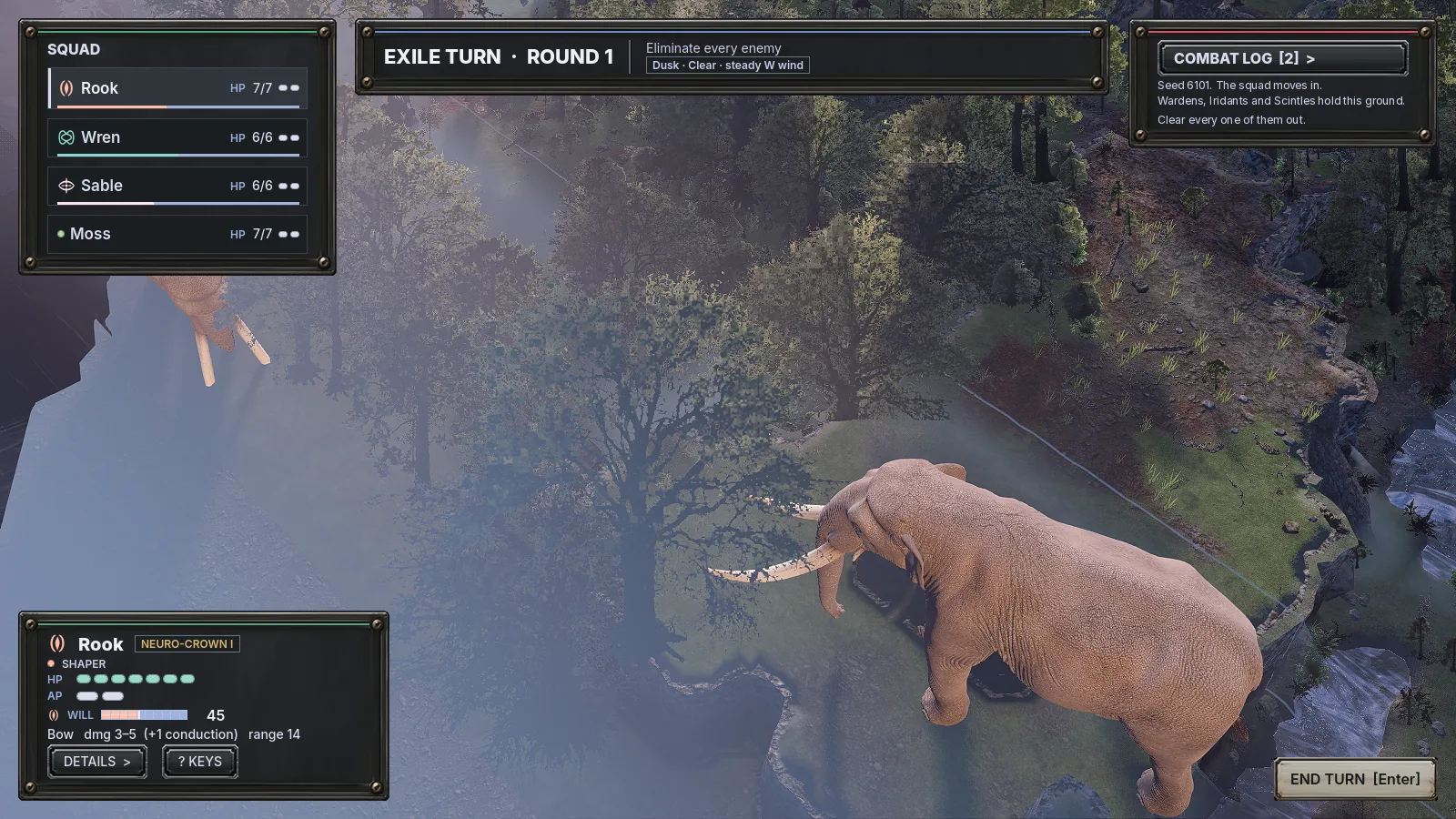
The beasts of the period stand on the edge of the board. They never touch the rules: no cover, no blocking, no line of sight, and nobody can target them. A herd keeps to the ring just past the board. When a unit the squad can see comes within 11 tiles, the herd moves off along the edge, and it never reacts to a hidden enemy, so it never gives one away. Like the plants, they are drawn from Europe's fossil record, and the world keeps its own rules where the record runs out.
Each mission gets one herd species from its country, and where the country has them, a few predators far off on the ring. A predator keeps well clear of the herd and never grazes. Salt flats and brine shores have no herds at all.
Who lives where
| Country | Herds | Far off |
|---|---|---|
| Forest | Mastodon, Anancus, Two-horned rhino, Tapir, Small wild pig, Dama-like deer and Colobine monkey | - |
| Parkland | Mastodon, Anancus, Two-horned rhino, Dama-like deer, Wild ox and Colobine monkey | Scimitar-toothed cat |
| Marsh | Mastodon, Tapir and Small wild pig | - |
| Coast | Dama-like deer and Small wild pig | - |
| Steppe | Wild ox and Giant tortoise | Scimitar-toothed cat, Giant cheetah and Running hyaena |
| Scrub | Giant tortoise and Wild ox | Giant cheetah and Running hyaena |
| Desert rim | Giant tortoise | Running hyaena and Giant cheetah |
| The Balearic heights | Island goat-antelope, Giant rabbit | - |
The Balearic heights above the dry basin have only their island dwarfs. The giant tortoise only walks the south.
The beasts
The mastodon is the largest and the island's giant rabbit the smallest. Heights are to the top of a tusk, an antler or the head.
| Beast | Height | Length | Group of | Kind |
|---|---|---|---|---|
| Mastodon (Mammut borsoni) | 4 m | 6.9 m | 2-3 | herd |
| Anancus (Anancus arvernensis) | 2.7 m | 4.8 m | 2-3 | herd |
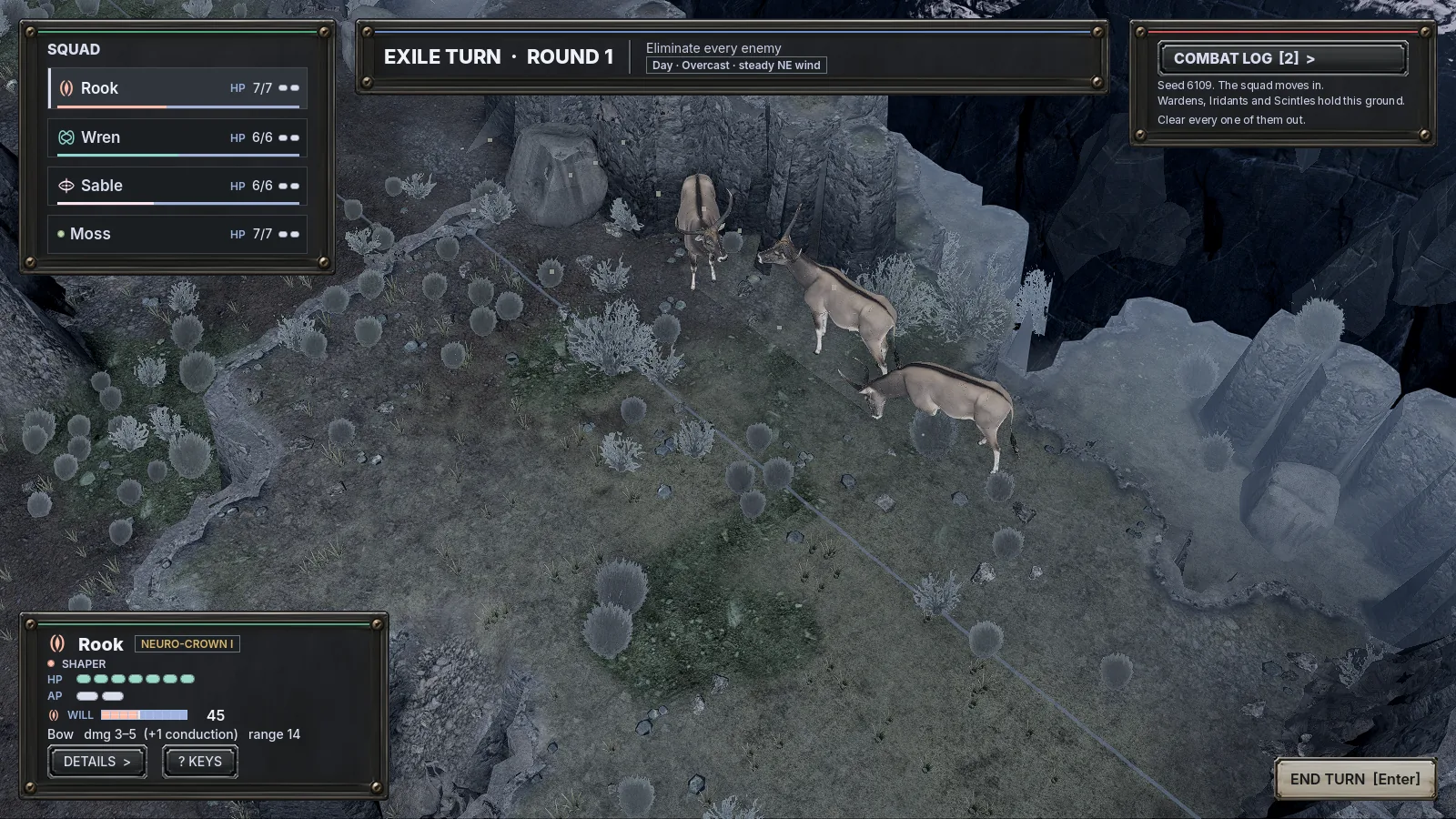
| Wild ox (Leptobos) | 1.95 m | 2.07 m | 4-6 | herd |
| Two-horned rhino (Stephanorhinus) | 1.75 m | 3.6 m | 1-2 | herd |
| Dama-like deer (Pseudodama) | 1.5 m | 1.4 m | 3-5 | herd |
| Tapir (Tapirus arvernensis) | 0.9 m | 1.7 m | 1-2 | herd |
| Giant tortoise (Titanochelon) | 0.85 m | 1.65 m | 1-3 | herd |
| Island goat-antelope (Myotragus) | 0.75 m | 1.1 m | 3-5 | herd |
| Small wild pig (Sus arvernensis) | 0.7 m | 1.2 m | 3-5 | herd |
| Colobine monkey (Mesopithecus) | 0.65 m | 1 m | 3-5 | herd |
| Giant rabbit (Nuralagus rex) | 0.5 m | 0.8 m | 2-4 | herd |
| Scimitar-toothed cat (Homotherium) | 1.2 m | 1.95 m | 1-2 | predator |
| Giant cheetah (Acinonyx pardinensis) | 1.15 m | 1.8 m | 1 | predator |
| Running hyaena (Chasmaporthetes lunensis) | 1 m | 1.35 m | 2-3 | predator |
Leptobos, the wild ox
Leptobos was a wild ox: an early cattle, lean and long-legged, nothing like a farm cow. In Messalith it grazes the steppe, the scrub and the open parkland in herds, and it is the beast the squad is most likely to meet on open ground. The first model looked too much like a cow, so it was made again as a lean wild ox with a dark stripe down its spine.
And the others
Crows, doves, bees and three-toed horses, and the Tuatha's Ramapithecus, are on the animals page.